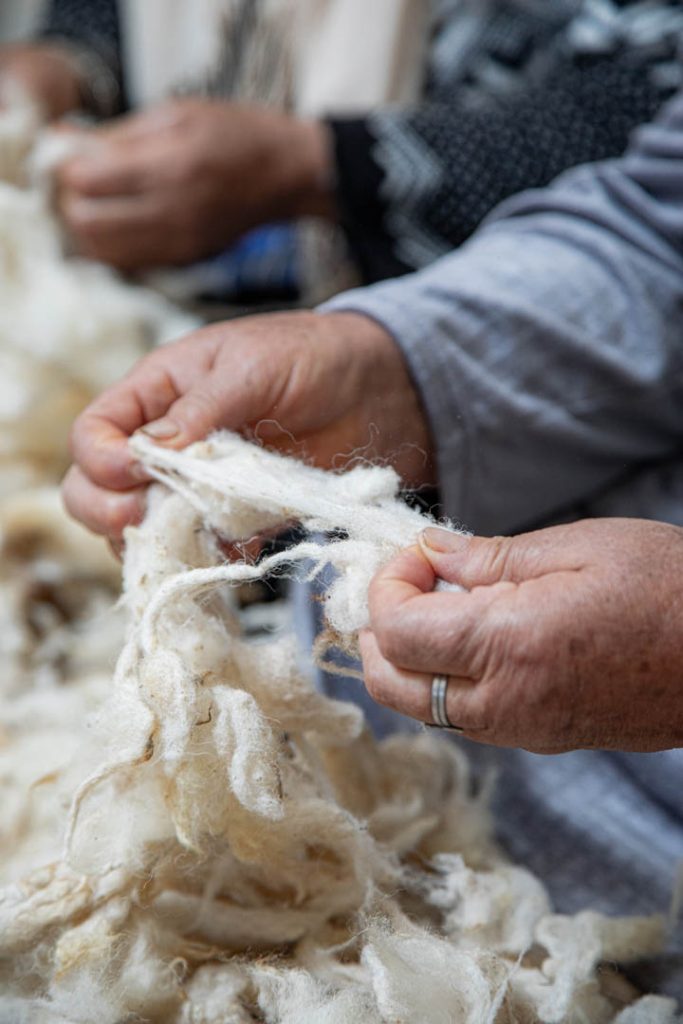
After shearing, the raw wool appears as a dense fleece, imbued with the scents of the sheepfold and the earth. In the past, groups of women, united by the “Twiza” (a community bond), gathered on the banks of the Bouregreg or its tributaries to wash this precious material.
With their hands submerged in clear water, the gestures are passed down from mother to daughter. The plant “Tighachte,” a soapwort with foaming properties, is rubbed between the palms. It gently purifies the wool, leaving it soft and fragrant. When the dirt is more ingrained, Marseille soap is added, and the water is heated over a wood fire, releasing volutes of wet wool and burning wood.
Once washed, the wool is gathered in reed baskets, where it is wrung out with the strength of their arms. It is then laid out in the sun on palm mats. The children play around, songs rise, and the river murmurs, complicit.
This moment is not just a task. It is a rite, a way of life where nature, time, and women come together in harmony.