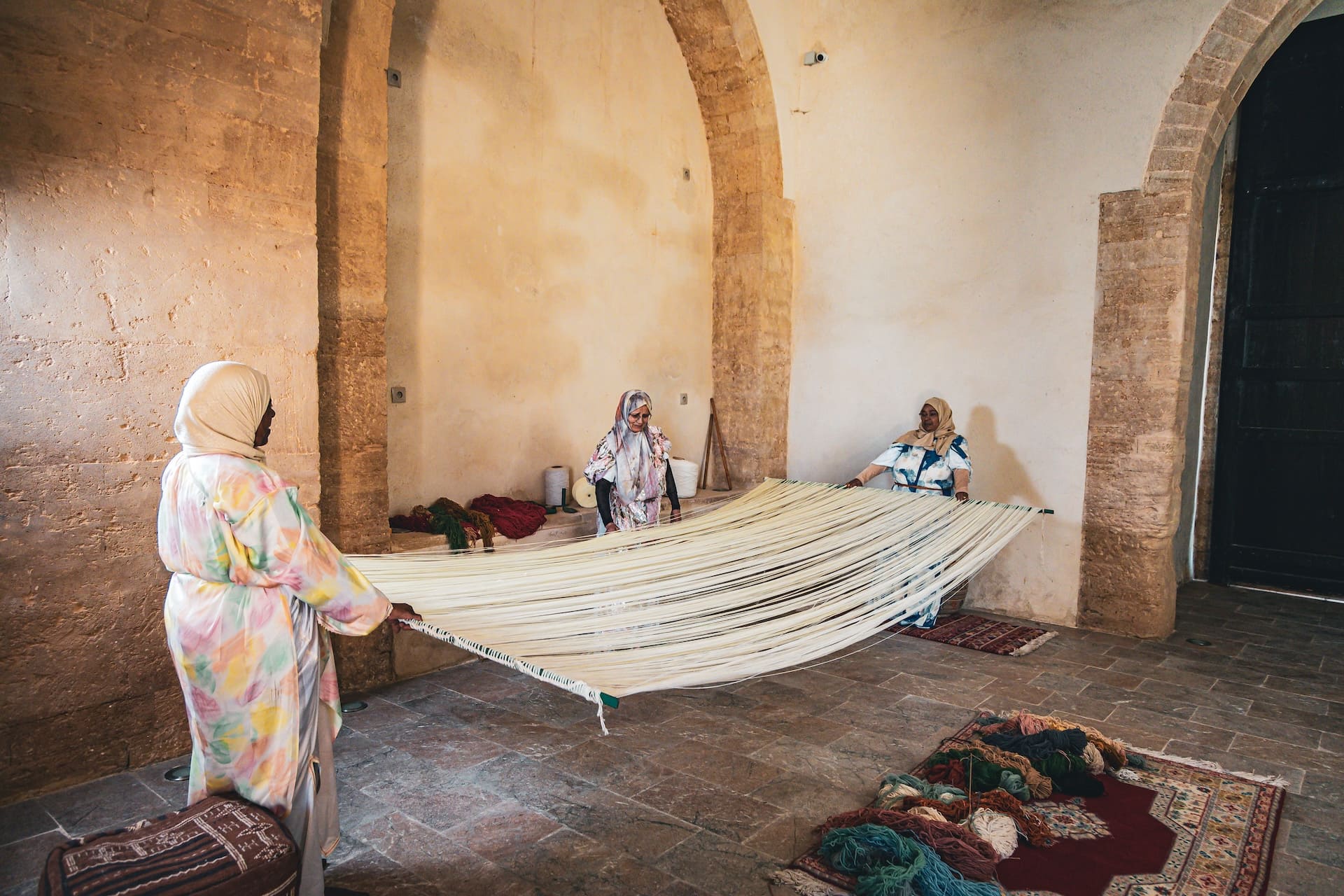
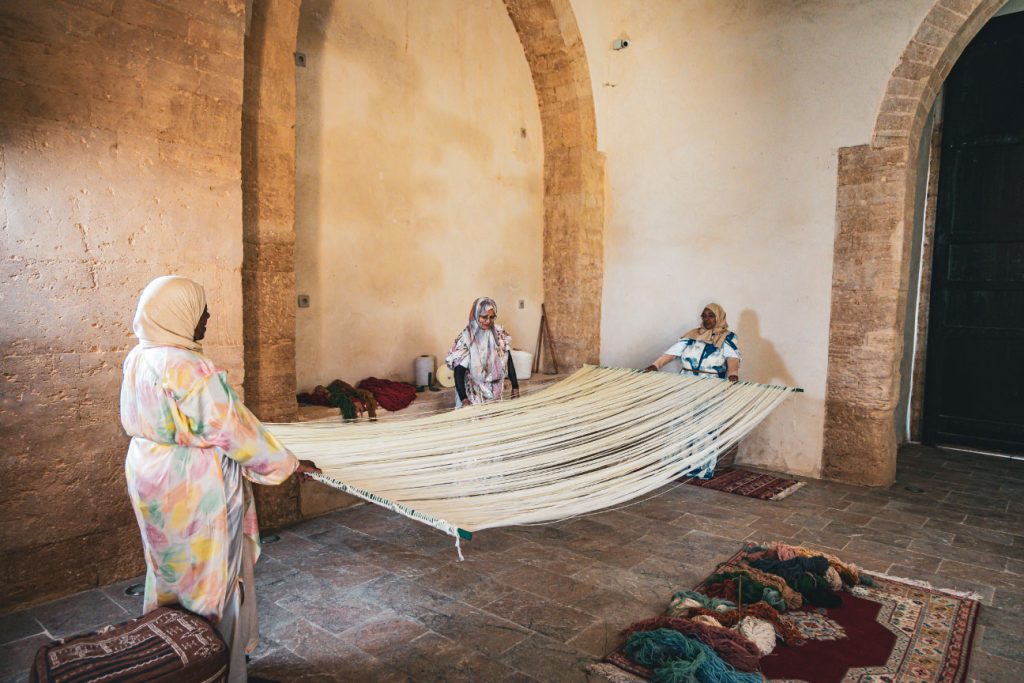
Once the threads of the chain have been warped and their sheet has been harmoniously spread out, a solemn step follows: mounting the chain on the loom. This pivotal moment marks the entry of the work into its decisive phase. It is about erecting the theater of weaving, stretching the threads across the two beams, so that the carpet can be born in order and light.
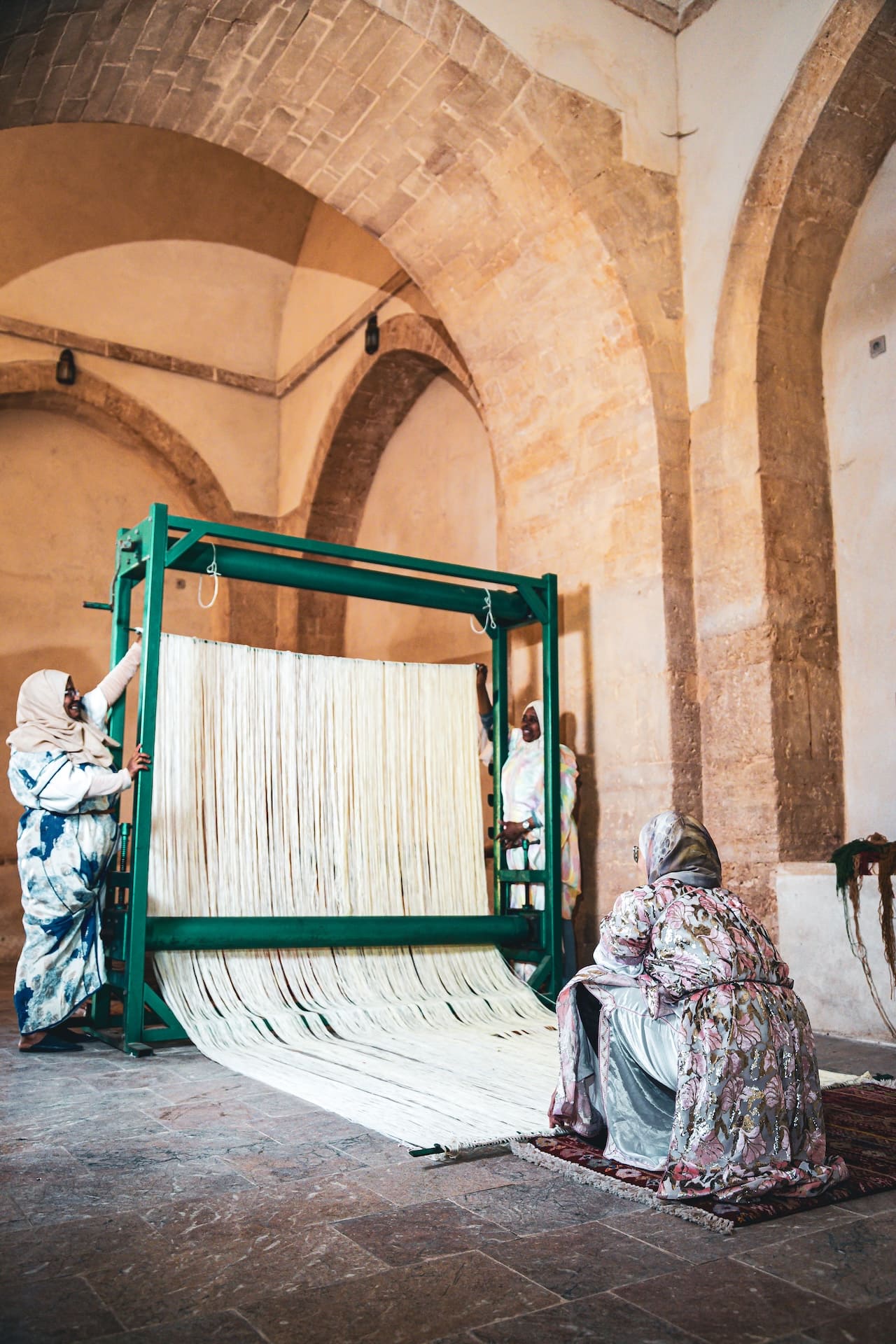
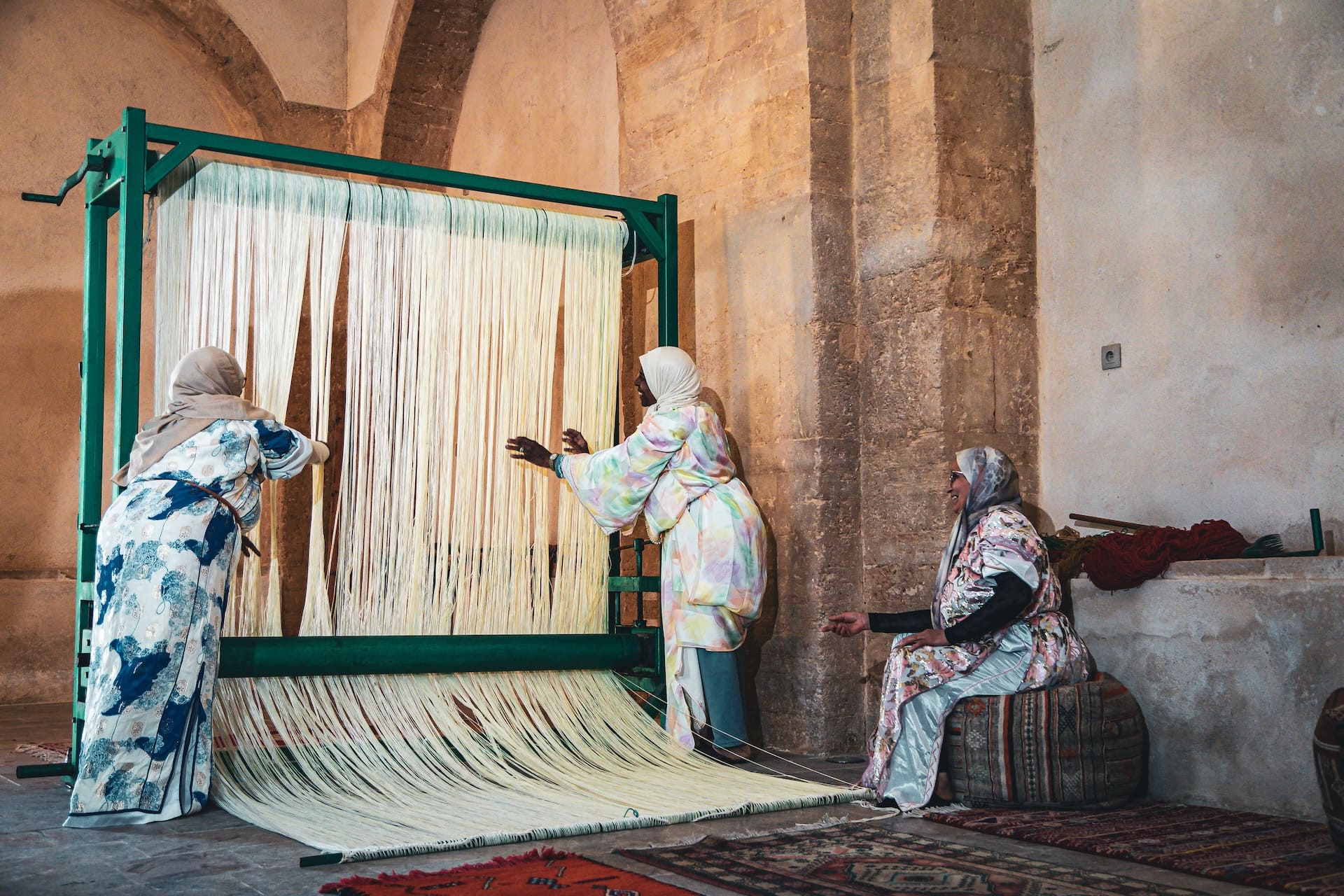
In the past, the loom was entirely made of wood. Its vertical posts, worn by the years, seemed alive, breathing with the rhythm of generations. The “ensouple-tapis” (the lower beam) was fixed at the bottom, between the two posts. The “ensouple-fils” (the upper beam), on the other hand, was fastened at the top, securely tied with strong ropes. Between these two axes, the sheet of the chain stood upright and regular.
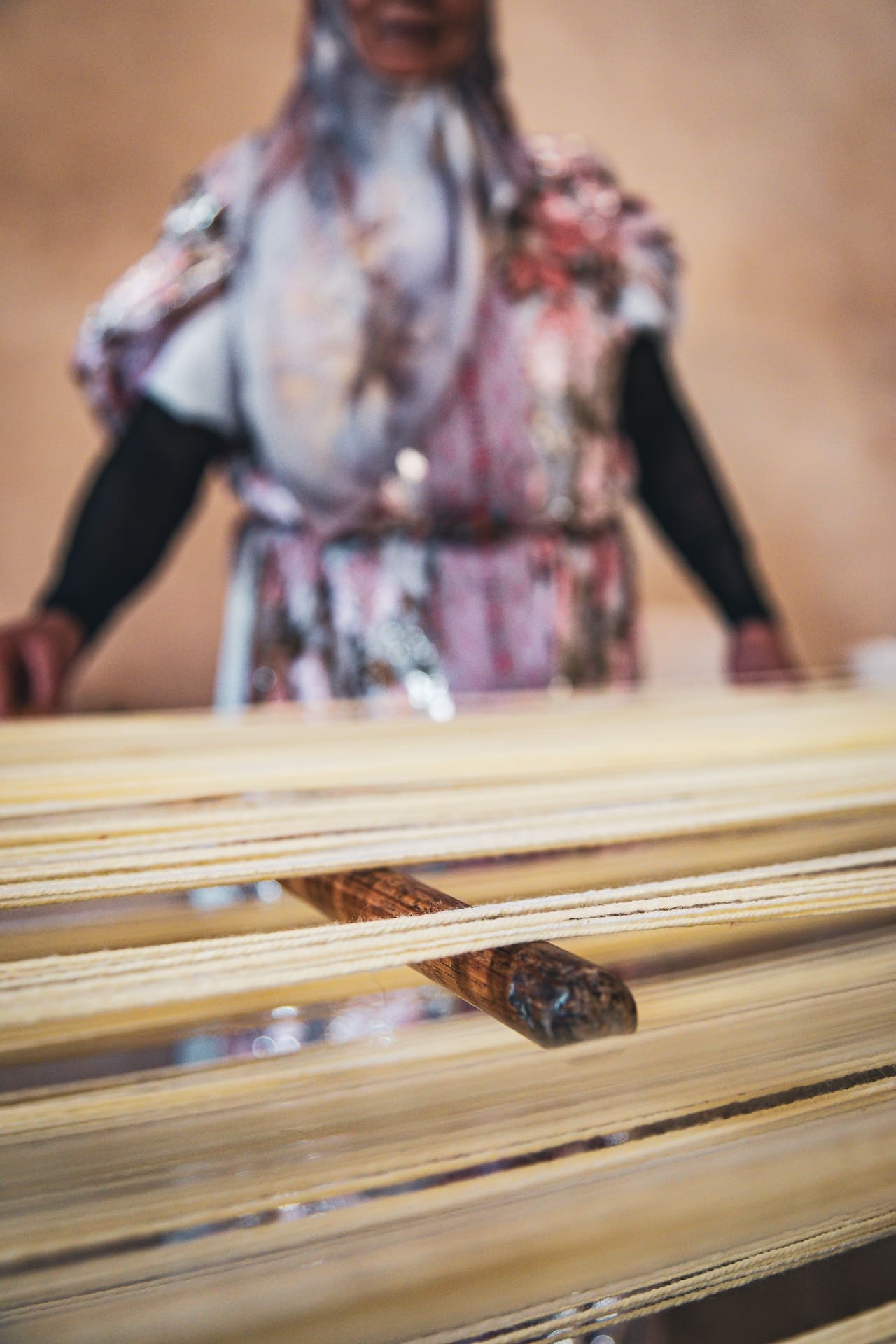
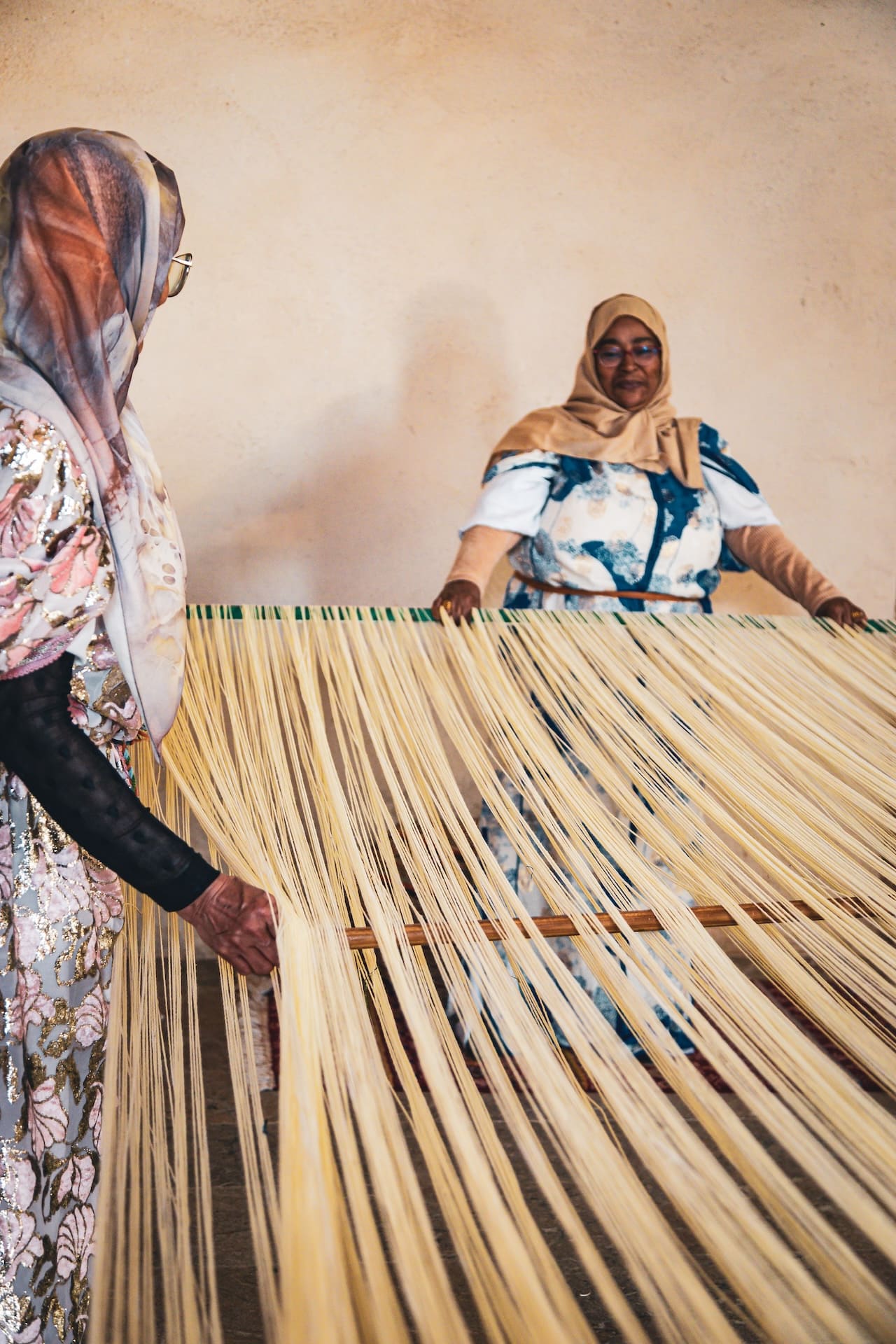
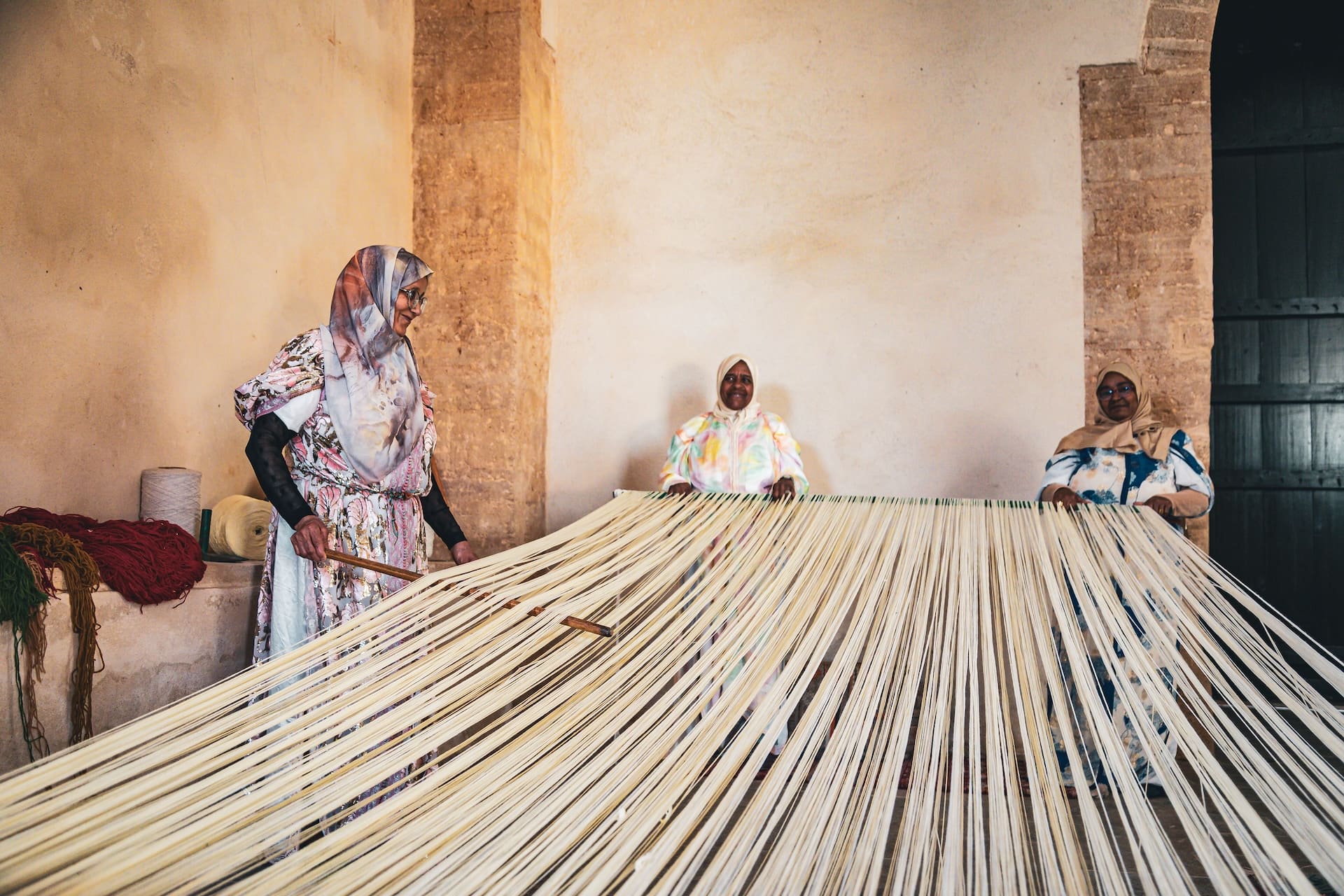
The weavers performed this setup with ritualistic precision. The sheet of the chain, still flexible and floating, was first wound onto the “ensouple-fils,” then slowly unrolled until it reached the “ensouple-tapis.” There, it was carefully fixed on the “ensouple-tapis,” with the threads stretched together, to ensure equal tension, an essential condition for the future beauty of the carpet. This work required patience, attention, and a kind of almost sacred respect for the material. For a well-mounted chain is already a promise of a successful masterpiece.
With the arrival of metal looms, the method evolved, but the spirit remains. Now, the metal rods, on which the chain has been spread, are simply placed against the tubular metal beams of the loom. The weavers then begin to wind the sheet of the chain onto the upper beam. Slowly, methodically, they guide the sheet until it reaches the lower beam. Once the other end is fixed, the chain is stretched, suspended in space, ready to vibrate under the blows of the beaters.
But before the actual weaving begins, another key piece enters the scene: the Quilo. This wooden board, pierced with precisely spaced nails, one centimeter apart, and arranged in a 10×10 cm grid on both sides, plays a fundamental role. The Quilo is introduced between the two sheets of the chain, with even threads on one side and odd threads on the other. It acts as a giant comb, a musical staff for the threads that arranges the fibers according to the density of the carpet to come.
The weavers pass the threads two by two, sometimes three or four, between successive nails, depending on the quality requirements of the carpet. This operation demands both precision and sensory intuition, as each thread, each gap, each tension affects the regularity of the weaving. The Quilo is not just a tool; it is a filter of harmony, a distributor of balance, a guardian of invisible geometry.
Once the threads have passed through the Quilo, it is suspended to the upper beam using two strong ropes. The loom is now fully set up, and the assembly is complete. The loom breathes. It is ready to receive the first rows, the first wool, the first colors.